
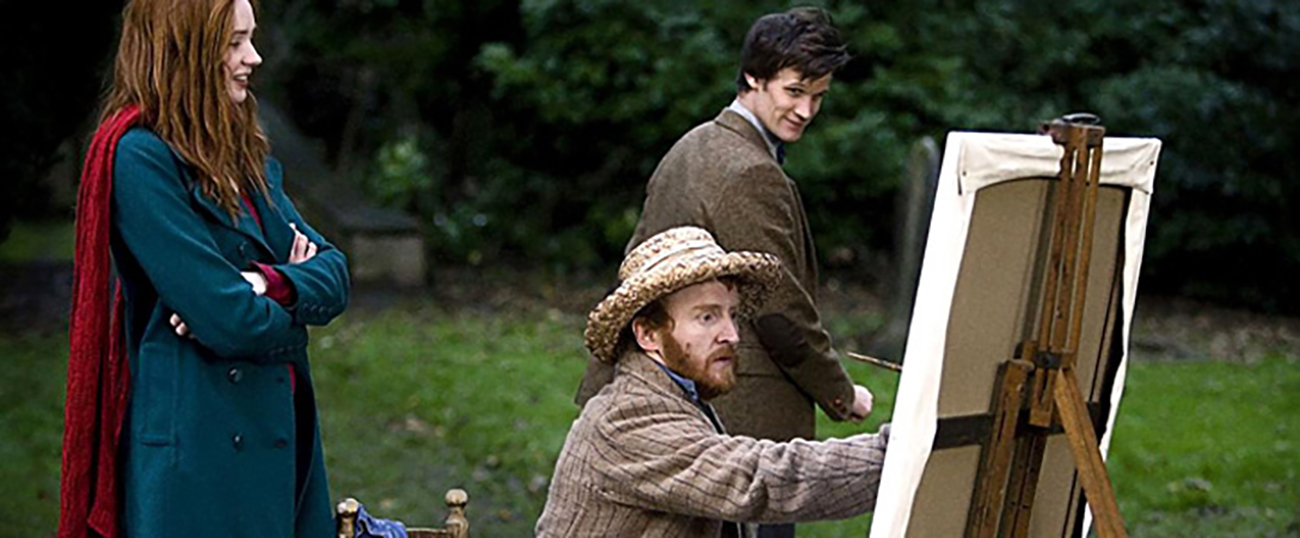
The Doctor takes Amy to meet Vincent van Gogh. There’s art, there’s monsters, and there’s an ending that will leave you ugly-crying into your sketchbook.
Short Synopsis
The Doctor and Amy visit 1890 Provence, where they meet Vincent van Gogh, spot a monster only Vincent can see, and battle it in a café, a church, and a cornfield. But the real story is about Vincent’s genius, his pain, and what it means to be remembered.
Extended Storyline
We start in modern-day Paris, where the Doctor and Amy are wandering an art gallery. They’re admiring Van Gogh’s work when the Doctor suddenly spots something odd: a monstrous face lurking in one of the paintings. Because of course the Doctor is the kind of person who notices “oh look, that sunflower painting has an extra set of fangs.”
So naturally, he whisks Amy off in the TARDIS to 1890 France. They quickly find Vincent van Gogh in his natural habitat: being ridiculed by locals and drowning in loneliness. Tony Curran absolutely nails Vincent’s combination of fragile brilliance and raw despair, instantly making him one of the best one-off guest characters in the show’s history.
The Doctor and Amy befriend him, despite Vincent insisting he’s “mad” and worthless. Amy, ever the enthusiastic cheerleader, encourages him, while the Doctor tries (and mostly fails) to be tactful about not mentioning future fame and galleries.
But there is a monster — a big, invisible chicken-dragon called the Krafayis. It’s only visible to Vincent, which makes fighting it a little tricky. Cue some slapstick moments where the Doctor swings a chair at thin air while Vincent yells directions. Eventually, the gang tracks the creature to a church. After a tense, tragic confrontation, the Krafayis is killed — but not before it’s revealed to be blind and lashing out in fear. This moment hits hard: it’s not evil, just misunderstood and alone, a living metaphor for Vincent himself. (Yes, the show is laying it on thick. No, it doesn’t make it hurt less.)
Monster aside, the emotional center of the episode is Vincent’s battle with depression. Amy, shaken by his sadness, tries to lift him up — and the Doctor, in one of his most compassionate moves ever, decides to give Vincent a gift. He takes him forward in time to that Paris art gallery, where Bill Nighy’s kindly curator delivers a heartfelt monologue about Van Gogh being “not only the world’s greatest artist, but also one of the greatest men who ever lived.”
Vincent stands in the gallery, overwhelmed as strangers admire his work, finally realizing how deeply he will be loved by future generations. And then comes the gut punch: when the Doctor and Amy return him to 1890, history hasn’t changed. Vincent still dies by suicide, only a few weeks later.
Amy is devastated — she wanted to save him, to alter his fate. The Doctor gently explains that life isn’t that simple: they can’t always rewrite tragedy, but they can add to someone’s pile of good moments. And that matters.
Back at the gallery, Amy looks for “dozens more paintings” Vincent might have made had he lived longer. Instead, she finds just one subtle change: his painting of sunflowers, now inscribed “For Amy.” Ouch. Right in the heart.