
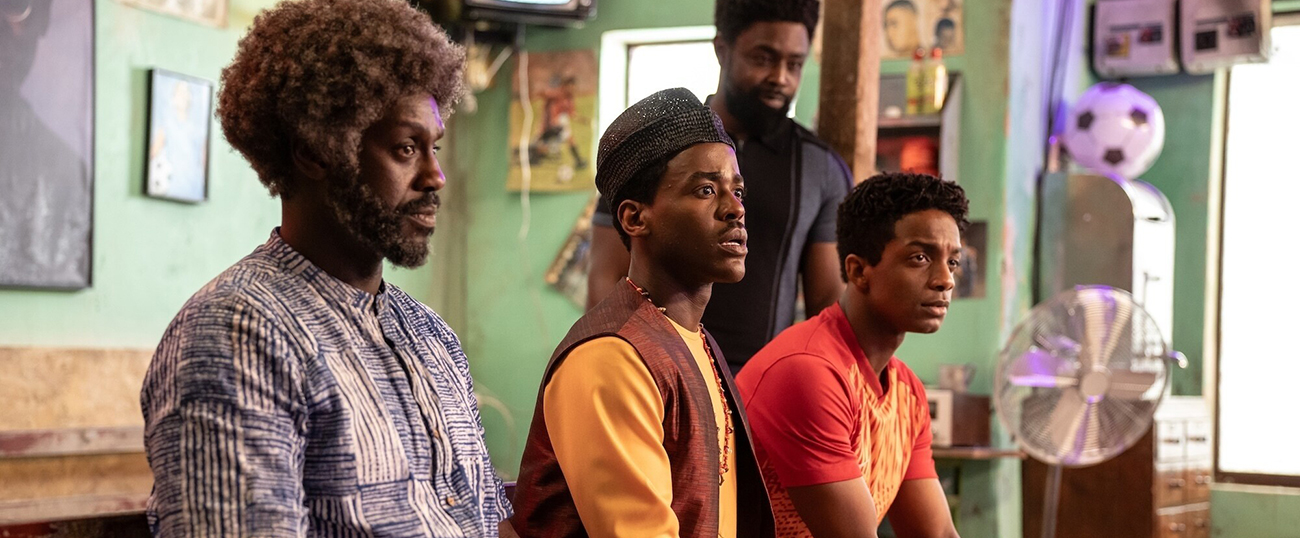
Barber shop gossip has never been so literally deadly.
Short Synopsis
The Doctor and Belinda land in Lagos, find a barbershop where stories fuel an engine (yeah, you read that right), and must stop a grudge-holding barber from cutting everyone’s future short.
Extended Storyline
The TARDIS drops the Doctor and Belinda into Lagos, 2019 — because clearly when you want answers about your cosmic destination, you swing by your Doctor friend’s barber shop first. His friend Omo Esosa runs the shop, chilling with customers, chin massages, small talk, everything’s pretty casual… until you notice that there are missing postersfor some of the guys who hang out there. Big red flag. Also alarms in the TARDIS, because yes, even the TARDIS senses “uh oh, this isn’t just a haircut.”
Enter the Barber (Ariyon Bakare), with calm menace and scissors. He “needs stories,” he says. Stories are his fuel. Stories are his power. So every time someone sits in that barber’s chair and tells a story, the shop’s engine feeds it through something called the Engine — which turns out to be a gigantic spider-machine floating in space, crawling across a web of stories, called the Nexus. Because why just collect gossip when you can pilot a cosmic spider that eats all the tales?
Belinda and the Doctor get wrapped up when Rashid, Tunde, and Obioma (customers of the barber’s chair) are revealed to be captives, stuck in this loop: tell a story, haircut, fuel the Engine, hair grows back (because regeneration-of-hair is apparently Doctor Who’s budget cheat code), rinse and repeat. The Barber isn’t evil for evil’s sake — he’s been forgotten, uncredited, bumped aside by the gods of storytelling. His grudge is cosmic: he wants to take revenge, to destroy the Gods (Anansi etc.) who, in his eyes, replaced him. The Barber may or may not have invented the idea of the gods by writing about them — myth-making on steroids.
Abby (later revealed as Abena, Anansi’s daughter), plays the tragic insider. She was scorned, sidelined. She’s bitter, hopeful, and genuinely, quietly badass without wearing a cape. She recognizes the Doctor, remembers stories of power, of betrayal. She braids the Doctor’s hair — literally weaving a map of the Engine’s corridors into the strands. Because nothing says “folk horror meets sci-fi” like hair-mapping.
The Doctor’s story-telling turns into a weapon. He tells a story about Belinda saving someone, which rips through the Engine’s systems more effectively than any explosive, because stories are powerful. Fueling the Engine becomes dangerous when the Engine is forced to absorb more than it can handle. There’s tension: will it explode? Will the spider mechanical body collapse? Will people be sucked into space webs like bad internet content?
At the climactic moment, corridors shift, hair grows back at absurd speeds, doors close, the Barber loses control. Belinda and the Doctor fight to free the captive storytellers. The Barber is confronted with what really hurts: not just being forgotten, but being used as an object of power. His rage isn’t magic, it’s wounded vanity. Ruby would say “That’s on brand for tragic side-villains.”
In the end, the Engine collapses under the weight of stories — the Doctor’s own life, all his incarnations flashing (past Doctors projecting on walls and screens), tales of hope, fear, rescue, loss. The Barber is defeated not by laser swords but by empathy, by Belinda’s words: “hurt people hurt people.” People tell him that his story doesn’t have to end with resentment. Omo offers him space, name, shop, redemption. Abena steps forward. They open the barbershop doors. The captives go free. The Doctor and Belinda leave — Lagos richer, the heartstrings tugged, the spider engine exploded.
Also: Jo Martin appears briefly as the Fugitive Doctor, reminding everyone that the Doctor’s timeline is messy. And there is hair. So much hair.